
On March 15, 1783, General George Washington, commander in chief of the Continental Army, walked into a meeting of his officers at Newburgh, New York, who were talking about marching on Congress.1 The shooting war was mostly over. Yorktown had been the last major campaign, but without a peace treaty the army could not go home, so about 7,500 troops sat along the Hudson watching the British army in New York City.2 Congress owed the officers back pay and the lifetime half-pay pensions it had promised in 1780, and it had no power to tax to raise the money.3
Partway through reading a letter from Joseph Jones, a Virginia member of Congress who had raised his orphaned nephew, James Monroe,4 Washington stopped and reached for a pair of reading glasses.5 “Gentlemen, you will permit me to put on my spectacles,” he said, “for I have not only grown gray but almost blind in service of my country.”6 The officers pledged their loyalty to Congress.7 Four days later, Congress voted them five years of full pay.6
Today is Veterans Day, and veterans are still waiting on Congress.
On December 1, disabled veterans and their survivors are due a 3.6 percent cost-of-living raise. Social Security’s raise happens on its own. The VA’s does not. Congress has to pass a bill every year directing the VA to apply it.8 This year’s Senate bill comes from the Veterans’ Affairs Committee’s Republican chairman, Jerry Moran of Kansas, and its top Democrat, Richard Blumenthal of Connecticut, with 15 cosponsors drawn from Republicans, Democrats, and independents.9 It was referred to committee on May 11, and the congressional record shows no action since.10 Last year’s bill passed the Senate by unanimous consent on November 9, the House on November 17, and was signed November 25.11
The formula is permanent. The payment still takes a vote.
The Day
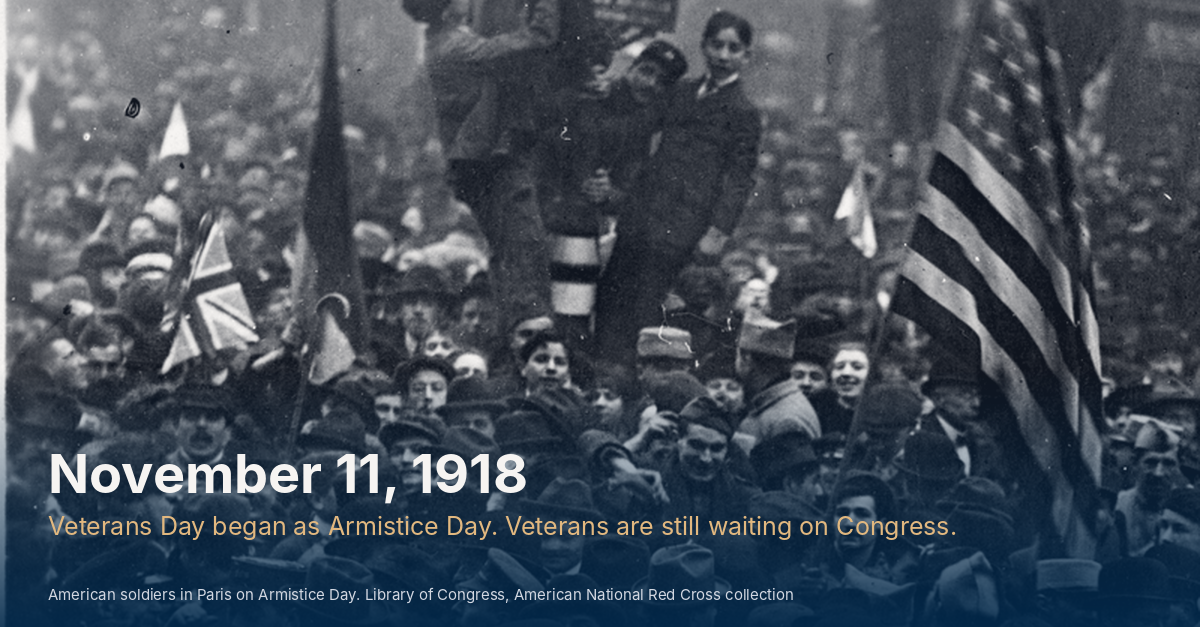
Veterans Day began as Armistice Day, the anniversary of the end of the fighting in the First World War on November 11, 1918. In 1919, King George V, great-great-grandson of George III, the king the colonies declared independence from, asked Britain for two minutes of silence. The Commonwealth has kept them since, and France made its own minute official in 1922.12 President Wilson called for parades and a pause in business at 11 a.m.13
Congress made Armistice Day a legal holiday in 1938.14 After the Second World War, Raymond Weeks, a veteran from Birmingham, Alabama, asked Army Chief of Staff Dwight Eisenhower for a holiday honoring all veterans, and Birmingham held the first Veterans Day parade in 1947. In 1954, Congress renamed the day, and President Eisenhower signed the law.15
In 1968, Congress moved the holiday to an October Monday to give federal workers a three-day weekend. President Johnson promised more family time and “greater industrial and commercial production.”16 Veterans’ organizations answered that the date was the point, and in 1978 the holiday went back to November 11.17
Even the date needed a defense. The benefits needed more.
The Promises
Washington had talked his officers out of marching on Congress. Three months later, unpaid soldiers in Pennsylvania did what the officers had only talked about. In June 1783, several hundred of them surrounded the Pennsylvania State House, now Independence Hall, with fixed bayonets to demand their back pay.18 Pennsylvania refused to call out its militia to disperse them. Shaken, Congress voted to leave Philadelphia and reconvened in Princeton.19
Most Continental soldiers discharged in good health received nothing.20 The Pension Act of 1818, prompted by President James Monroe, Jones’s nephew and himself a Continental Army veteran, paid only veterans who could prove they were poor. Not until 1832, 49 years after the war, did Congress pay pensions “without regard to rank, financial distress, or physical disability.”20
On March 4, 1865, Abraham Lincoln closed his second inaugural address with a promise “to care for him who shall have borne the battle and for his widow, and his orphan.”21 Union veterans organized to collect. The Grand Army of the Republic pressed Congress for ever more generous pensions, starting with the Arrears Act of 1879,22 and it campaigned for Black veterans to receive pensions on the same terms as white veterans. By 1893, Union pensions took more than 40 percent of federal revenue.23
The First World War generation was promised adjusted compensation in 1924: $1 for each day of service at home and $1.25 for each day overseas, paid in certificates that matured in 1945.24 In 1932, in the Depression, thousands of veterans camped across the Anacostia River from the Capitol to ask for the money early. The House voted to pay. The Senate did not.24 On July 28, police killed two veterans during an eviction. Army troops under General Douglas MacArthur, with Majors Dwight Eisenhower and George Patton, drove the rest out. The President twice told MacArthur to stop at the bridge. He crossed anyway, and the camps burned.25 Four years later, Congress authorized immediate payment over a veto.26
The memory of 1932 helped pass the GI Bill.26 Harry Colmery of the American Legion drafted it by hand in a room at the Mayflower Hotel in December 1943. In June 1944, it sat deadlocked 3 to 3 in conference. The deciding vote belonged to Rep. John Gibson, home sick in rural Georgia. The Legion found him at 11 p.m., had him driven 90 miles through a rainstorm to the Jacksonville airport, and flew him to Washington by morning. He cast the vote. The President signed the bill on June 22.27
The Pattern
One Congress makes the promise. A later Congress decides when to pay it. The gap closes when veterans organize, show up, and keep the date in front of Congress: the officers at Newburgh, the Grand Army of the Republic, the marchers on the Anacostia, the Legion’s overnight drive, and one man in Birmingham with a parade.
The current Congress can move fast when it wants to. Last year’s bill went from Senate passage to the President’s signature in 16 days.11 This year’s bill has not left committee.
When we moved to Virginia, my kids joined a Scout troop run by veterans, many of them retired senior officers, alongside people still serving, some in the Pentagon’s E Ring. It was the best-run troop I have ever seen. The veterans ran the adult jobs efficiently and effectively, and they understood leadership well enough to make sure the Scout jobs were done by Scouts. It sounds easy. It is the hardest thing for an adult leader to do.
The Scout motto is “Be Prepared.”28 Those veterans taught it as a set of habits: show up, organize, divide the work, and see it through. Every generation in this piece needed the same habits, because each one learned that a promise from Congress is not yet a payment. The veterans in that troop—and those all around our Republic—have earned their raise on December 1.
General Washington got a vote in four days. This year’s bill has 20.
Notes
- “George Washington’s Commission as Commander in Chief,” Library of Congress, archived January 9, 2009, https://webarchive.library.unt.edu/eot2008/20090109093641/http:/www.loc.gov/rr/program/bib/ourdocs/commission.html; “Newburgh Address,” George Washington’s Mount Vernon, https://www.mountvernon.org/library/digitalhistory/digital-encyclopedia/article/newburgh-address/.↩
- “Year in Revolution, 1783: Newburgh, New York,” American Revolution Institute of the Society of the Cincinnati, June 28, 2026, https://www.americanrevolutioninstitute.org/?p=31815; “New Windsor Cantonment,” George Washington’s Mount Vernon, https://www.mountvernon.org/library/digitalhistory/digital-encyclopedia/article/new-windsor-cantonment/.↩
- “Year in Revolution, 1783: Newburgh, New York,” American Revolution Institute of the Society of the Cincinnati, June 28, 2026, https://www.americanrevolutioninstitute.org/?p=31815; “The Newburgh Conspiracy,” American Battlefield Trust, https://www.battlefields.org/learn/articles/newburgh-conspiracy.↩
- James Madison to Joseph Jones, [ca. 6 January] 1783, editorial note, Founders Online, National Archives, https://founders.archives.gov/documents/Madison/01-06-02-0009.↩
- “The Newburgh Conspiracy,” American Battlefield Trust, https://www.battlefields.org/learn/articles/newburgh-conspiracy; “Joseph Jones and the Letter That Saved America,” Founder of the Day, https://founderoftheday.com/founder-of-the-day/joseph-jones.↩
- “The Newburgh Conspiracy,” American Battlefield Trust, https://www.battlefields.org/learn/articles/newburgh-conspiracy.↩
- “Year in Revolution, 1783: Newburgh, New York,” American Revolution Institute of the Society of the Cincinnati, June 28, 2026, https://www.americanrevolutioninstitute.org/?p=31815.↩
- Suzanne Blake, “VA Benefits Will Get COLA Boost, Some Veterans Worry It’s Not Enough,” Newsweek, October 16, 2026, https://www.newsweek.com/va-benefits-will-get-cola-boost-some-veterans-worry-its-not-enough-12582123.↩
- Senate Committee on Veterans’ Affairs, “Sens. Moran, Blumenthal Introduce Bipartisan Legislation to Deliver Annual Cost-of-Living Increase for Veterans,” May 15, 2026, https://www.veterans.senate.gov/2026/5/sens-moran-blumenthal-introduce-bipartisan-legislation-to-deliver-annual-cost-of-living-increase-for-veterans.↩
- Veterans’ Compensation Cost-of-Living Adjustment Act of 2026, S. 4487, 119th Cong. (2026), https://www.govinfo.gov/content/pkg/BILLS-119s4487is/html/BILLS-119s4487is.htm; S. 4487, All Actions, Congress.gov, https://www.congress.gov/bill/119th-congress/senate-bill/4487/all-actions (only action: May 11, 2026, “Read twice and referred to the Committee on Veterans’ Affairs,” as of November 11, 2026).↩
- Senate Committee on Veterans’ Affairs, “PASSED: Sens. Moran, Blumenthal Bipartisan Legislation to Deliver Cost-of-Living Increase for Veterans,” November 9, 2025, https://www.veterans.senate.gov/2025/11/passed-sens-moran-blumenthal-bipartisan-legislation-to-deliver-cost-of-living-increase-for-veterans; “S. 2392: Veterans’ Compensation Cost-of-Living Adjustment Act of 2025,” Legisletter, https://legisletter.org/bill/s2392-veterans-compensation-costofliving-adjustment-act (Pub. L. No. 119-42).↩
- Romain Fathi, “100 Years since the WW1 Armistice, Remembrance Day Remains a Powerful Reminder,” The Conversation, republished by OnlineKhabar, https://english.onlinekhabar.com/100-years-since-the-ww1-armistice-remembrance-day-remains-a-powerful-reminder.html; “Queen Victoria (1819–1901),” Royal Collection Trust, https://albert.rct.uk/queen-victoria-1819-1901 (Victoria was the granddaughter of George III; George V was her grandson).↩
- “The Origins of Veterans Day,” Military.com, November 10, 2025, https://365.military.com/feature/2025/11/10/origins-of-veterans-day.html.↩
- Northwestern Pritzker School of Law Library, “A Documentary History of Veterans Day,” November 11, 2015, https://libraryblog.law.northwestern.edu/2015/11/11/a-documentary-history-of-veterans-day/ (Act of May 13, 1938, ch. 210, 52 Stat. 351; Act of June 1, 1954, Pub. L. No. 83-380, 68 Stat. 168; Act of June 28, 1968, Pub. L. No. 90-363, 82 Stat. 250; Act of Sept. 18, 1975, Pub. L. No. 94-97, 89 Stat. 479).↩
- Northwestern Pritzker School of Law Library, “A Documentary History of Veterans Day,” November 11, 2015, https://libraryblog.law.northwestern.edu/2015/11/11/a-documentary-history-of-veterans-day/ (Act of May 13, 1938, ch. 210, 52 Stat. 351; Act of June 1, 1954, Pub. L. No. 83-380, 68 Stat. 168; Act of June 28, 1968, Pub. L. No. 90-363, 82 Stat. 250; Act of Sept. 18, 1975, Pub. L. No. 94-97, 89 Stat. 479); “History,” National Veterans Day, https://nationalveteransday.org/history.↩
- Lyndon B. Johnson, “Statement by the President upon Signing the Uniform Holiday Bill,” June 28, 1968, American Presidency Project, https://www.presidency.ucsb.edu/documents/statement-the-president-upon-signing-the-uniform-holiday-bill.↩
- “The Origins of Veterans Day,” Military.com, November 10, 2025, https://365.military.com/feature/2025/11/10/origins-of-veterans-day.html; Northwestern Pritzker School of Law Library, “A Documentary History of Veterans Day,” November 11, 2015, https://libraryblog.law.northwestern.edu/2015/11/11/a-documentary-history-of-veterans-day/ (Act of May 13, 1938, ch. 210, 52 Stat. 351; Act of June 1, 1954, Pub. L. No. 83-380, 68 Stat. 168; Act of June 28, 1968, Pub. L. No. 90-363, 82 Stat. 250; Act of Sept. 18, 1975, Pub. L. No. 94-97, 89 Stat. 479).↩
- Princeton University Library, “Congress at Princeton,” https://dpul.princeton.edu/revolution250th/feature/congress-at-princeton.↩
- Princeton University Library, “Congress at Princeton,” https://dpul.princeton.edu/revolution250th/feature/congress-at-princeton; “The Continental Congress at Nassau Hall,” Princeton Alumni Weekly, https://paw.princeton.edu/article/continental-congress-nassau-hall.↩
- “Revolutionary War Veterans,” American Revolution Institute of the Society of the Cincinnati, https://www.americanrevolutioninstitute.org/lesson-plans/legacies-of-the-revolution/revolutionary-war-veterans/.↩
- U.S. Department of Veterans Affairs, “The Origin of the VA Motto,” archived October 6, 2012, https://webarchive.library.unt.edu/web/20121006201315/http://www.va.gov/opa/publications/celebrate/vamotto.pdf.↩
- “Grand Army of the Republic,” Dictionary of American History, Encyclopedia.com, https://www.encyclopedia.com/history/dictionaries-thesauruses-pictures-and-press-releases/grand-army-republic.↩
- Kathleen L. Gorman, “Civil War Pensions,” Essential Civil War Curriculum, https://essentialcivilwarcurriculum.vt.domains/civil-war-pensions.html.↩
- “The Bonus Army March,” DAV, 2020, https://www.dav.org/learn-more/news/2020/the-bonus-army-march/.↩
- “The Bonus Army March,” DAV, 2020, https://www.dav.org/learn-more/news/2020/the-bonus-army-march/; National Park Service, “Bonus Expeditionary Forces March on Washington,” https://www.nps.gov/articles/bonus-expeditionary-forces-march-on-washington.htm.↩
- “July 28, 1932: U.S. Army Disperses Bonus Marchers,” ABA Journal, https://abajournal.com/magazine/article/july_28_1932_u.s._army_disperses_bonus_marchers.↩
- “The GI Bill,” American Legion, https://centennial.legion.org/gi-bill; “GI Bill Signed into Law,” American Legion centennial timeline, https://centennial.legion.org/timeline/16945/gi-bill-signed-law (conference vote, June 10, 1944).↩
- Bryan Wendell, “Be Prepared: The Origin Story behind the Scout Motto,” On Scouting, May 8, 2017, https://onscouting.org/2017/05/08/be-prepared-scout-motto-origin/.↩
Is this issue on your desk?
Start a conversation