
The four largest hyperscalers are expected to spend $725 billion on the AI buildout this year, up from $410 billion last year.1 On Election Day, much of that money picked up a new set of approvers.
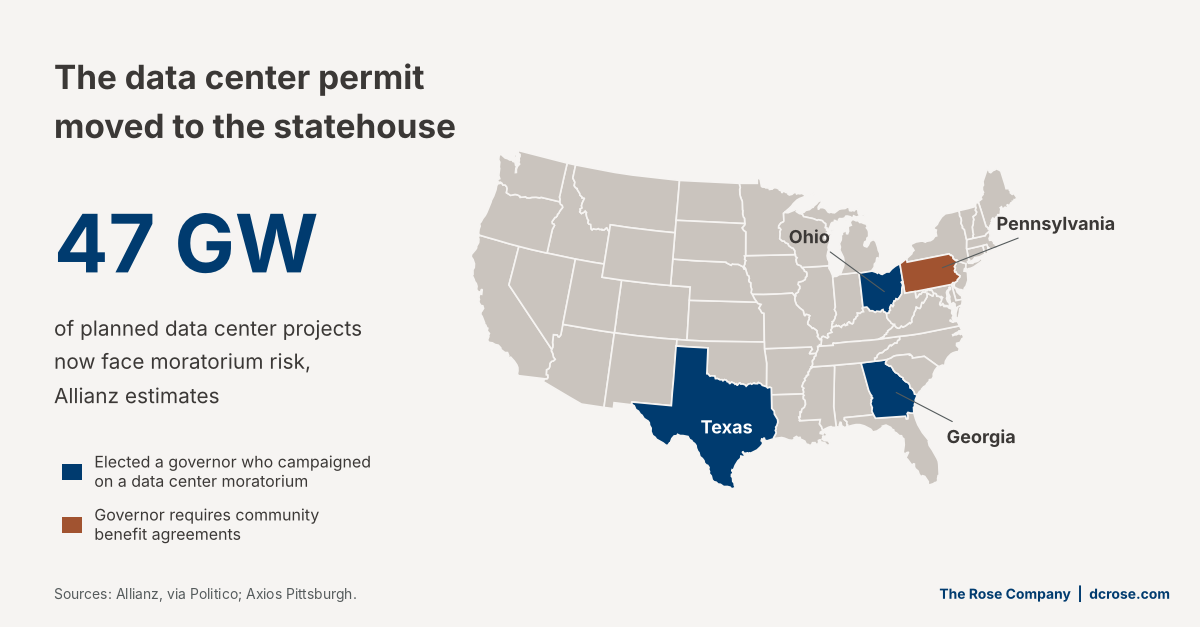
Voters in Texas, Ohio, and Georgia elected governors who campaigned on data center moratoriums. Allianz estimates that 47 gigawatts of planned data center projects now face moratorium risk.1 The day after the election, data center stocks slipped while the Dow and Nasdaq were up in morning trading.2
For the companies building and powering the buildout, the permit office that matters most is no longer in Washington. It is a governor’s desk in Austin, Columbus, or Atlanta, and the time to work it is before the new governors take office next year.
Texas shows why. The outgoing Republican governor had already called for an audit of data centers and, under pressure from voters, put a de facto temporary moratorium on the facilities. Analysts had expected the pause to ease if he won. The incoming governor’s campaign called for “an immediate moratorium on data centers” until the legislature can act.1 Both parties have been answering the same voters, and the policy moved in one direction across two administrations.
The pressure runs below the governors’ mansions, too. Voters approved local data center bans in Ohio, Florida, and elsewhere.1 By preliminary count, opponents won virtually all of 40 local ballot measures in 10 states. In Ohio alone, almost 20 towns, cities, and counties held votes.3
Allianz put the stakes in investor terms: “the risk is less an abrupt halt than a slower, costlier and more uneven buildout.”1 Slower and costlier can be negotiated.
Pennsylvania shows what the negotiation looks like. In August, Gov. Josh Shapiro signed an executive order that requires developers to offer host communities a community benefit agreement and to pay the costs tied to their electricity use.4 That is a price. A price can be met. His party also won the state Senate for the first time in four decades, so an executive order can become a statute.1
Washington is still at work. The Senate voted 73 to 25 on Monday to advance a bipartisan permitting bill and 62 to 21 on Tuesday to take it up.5 As I wrote Monday, the first vote is a vote to start. Whatever becomes of that bill, a moratorium is decided in the states.
I argued last month that the data center fight is local. The election made it statewide. Companies waiting for Washington to settle the siting rules are working the wrong building. In my experience, a new governor’s first months set the terms for the whole term, and the people writing those terms are on the transition team now.
What to do before the new governors take office:
- Map the transition teams in every state where you have a site or a plan, and learn who will staff the energy portfolio. That is where a first executive order would be drafted.
- Bring a community benefit offer before you are asked for one. An offer made early reads as partnership; the same offer made late reads as a concession.
- Show the grid math: who pays for the upgrades, when, and what ratepayers see on their bills.
- Brief the legislators. The Texas pledge runs until the legislature acts, so the legislature holds the off switch.
The buildout runs through the statehouse now. The strategy has to run there too.
Notes
- Benjamin Storrow, Zack Colman, and Sara Schonhardt, “Brace for the Shock Waves,” Politico Surge, Politico, November 4, 2026, https://www.politico.com/newsletters/politico-surge/2026/11/04/brace-for-the-shockwaves-01148704.↩
- Purvi Agarwal and Johann M Cherian, “AI Data-Center Stocks Slide, Renewables Rally after Democratic US Midterm Sweep,” Reuters, November 4, 2026, via Yahoo Finance, https://finance.yahoo.com/energy/articles/ai-data-center-stocks-dip-113427491.html; Storrow, Colman, and Schonhardt, “Brace for the Shock Waves.”↩
- Chris Teale, “Voters Reject Data Centers in Local Ballot Initiatives,” Route Fifty, November 4, 2026, https://www.route-fifty.com/artificial-intelligence/2026/11/voters-reject-data-centers-local-ballot-initiatives/417033/.↩
- Chrissy Suttles, “Shapiro Puts New Guardrails on Pa. Data Centers,” Axios Pittsburgh, August 18, 2026, https://axios.com/local/pittsburgh/2026/08/18/shapiro-data-center-rules-executive-order.↩
- Lindsey McPherson, “Senate Permitting Overhaul Clears Procedural Hurdle, but Obstacles Remain,” Washington Times, November 9, 2026, https://www.washingtontimes.com/news/2026/nov/9/senate-permitting-overhaul-clears-procedural-hurdle-obstacles-remain/; “Tuesday, November 10, 2026,” U.S. Senate Daily Press, https://dailypress.senate.gov/tuesday-november-10-2026.↩
Is this issue on your desk?
Start a conversation