
My basement flooded. The insurance adjuster has been incredibly helpful. The contractors have been something else: some of their estimates seem written to slip one past the insurance company. The adjuster has dozens of open cases, and the contractors seem to know they can flood the zone.
AI is on both sides of my claim. When I call my adjuster, a bot works out who I am and why I am probably calling, then patches me through. When I email him, a bot routes the message by the claim number in the subject line. We’re all used to this by now. Saturday Night Live has done sketches about talking to AI bots. Plural.1 On my end, AI gathered the list of lost property, the photos, the price comparisons, and descriptions written to the insurer’s guidelines. That donkey work would have taken me days, and there’s no guarantee my own third review would have caught every mistake.
Somebody has to check what the machine says. AI is just an intern, after all, and interns get their work reviewed. It’s standard insurance practice: my adjuster checks estimates one claim at a time, and I check what I receive from the contractors and the insurance company. The black box of AI, however, raises new questions. State insurance regulators want to know how insurers check their AI at scale. On Monday in Dallas, a working group of those regulators had version 7.0 of the AI Risk Evaluation Supplement on its agenda for adoption.2
The name is dull. The document is not. When state regulators examine an insurer, they look at how it treats its customers and whether it can pay its claims. The supplement gives them a set of questions about how that insurer uses artificial intelligence. Regulators in 12 states, including California, Colorado, and Virginia, piloted it this year. The version number shows how long they have been at it: the working group proposed the first version in the summer of 2025, and its AI work dates to 2019.3
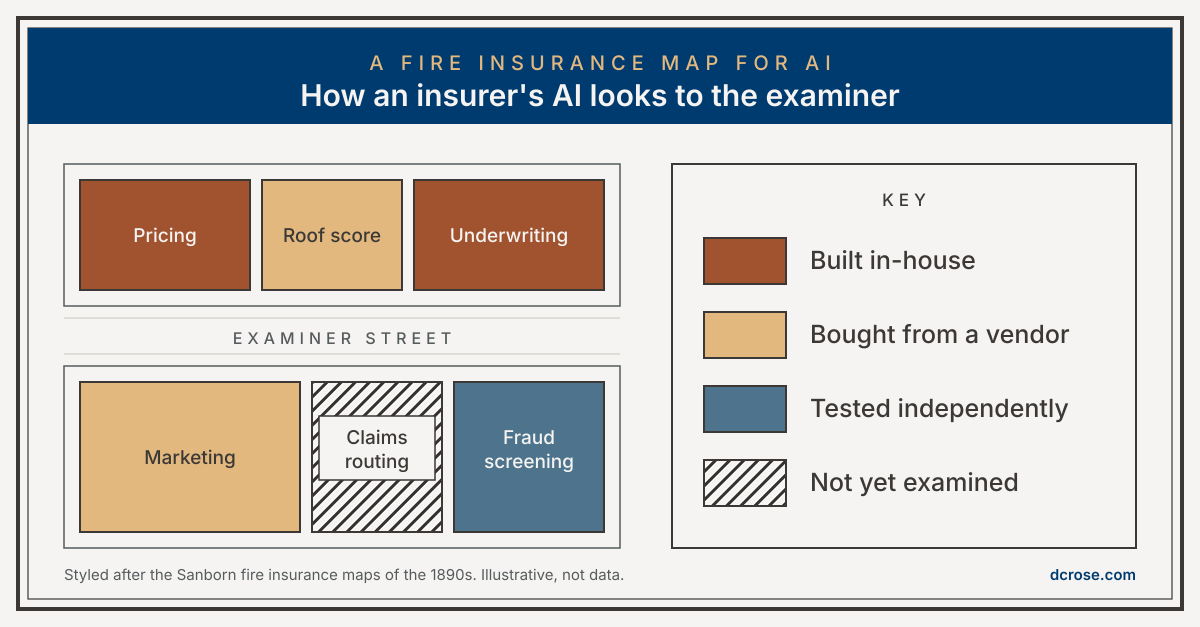
The industry’s use of AI is already wide. In surveys the regulators published in 2022 and 2023, 88 percent of auto insurers, 70 percent of home insurers, and 58 percent of life insurers said they use, plan to use, or plan to explore AI or machine learning. Some of those models come from outside vendors. One example is a model that reads aerial photographs and scores each roof’s condition, which the insurer then uses to set a price or decide whether to write the policy. A second working group is drafting a framework for such vendors, but the insurer stays accountable either way. It must still vet any outside model for its own book of business, then keep testing and watching it.4
The regulators worry about the customer. Their 2023 model bulletin, adopted in at least 24 states and the District of Columbia, warns of four risks: inaccuracy, unfair discrimination, data vulnerability, and a lack of transparency. A decision made with AI still has to meet the laws against unfair trade practices and unfair discrimination.5 This is another case of old laws finding new targets, as when the Federal Trade Commission dusted off a 1936 pricing law this fall. Innovation in insurance tends to bring oversight with it.
Insurers have faced a question like this before, and once they answered it themselves. And you thought there wasn’t going to be a history lesson.
In 1893, Chicago hosted the World’s Columbian Exposition. The fair ran on alternating current from Westinghouse, which had won the job over Edison, and the grounds were full of electrical installations nobody had proved safe. That May, the city’s fire underwriters hired a young electrical engineer named William Henry Merrill Jr. as an electrical inspector. Merrill proposed a laboratory that would use scientific principles to test products for fire and electrical safety. Backed by two regional fire insurance underwriters’ organizations, he opened an independent testing laboratory above a fire patrol station with two employees and $350 of equipment. It ran its first test on March 24, 1894, and incorporated as Underwriters’ Laboratories in 1901.6
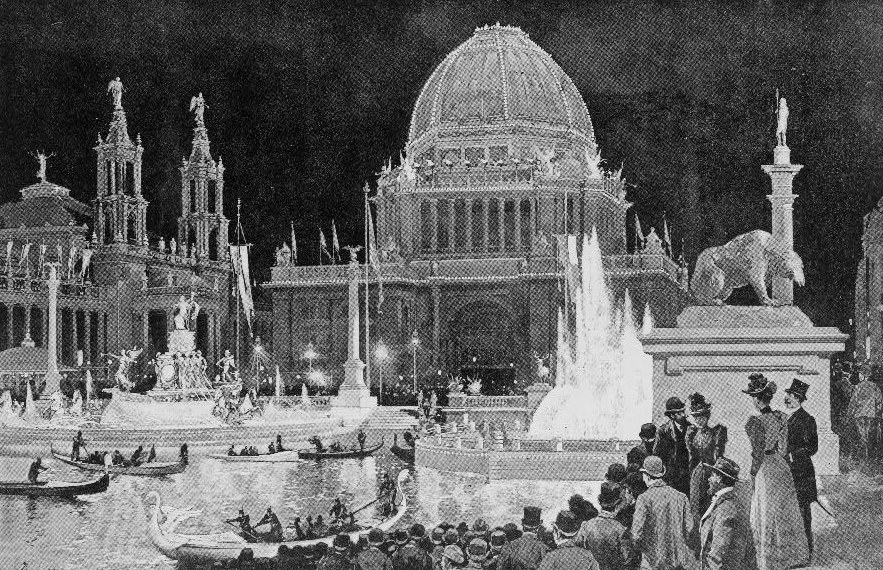
The fire insurers did not wait for a statute. When a building burned, they paid the claim, so they paid to test the equipment first. As underwriters know best, economics cuts through the noise and sentiment and provides the cold, heartless answers. I love the dismal science.
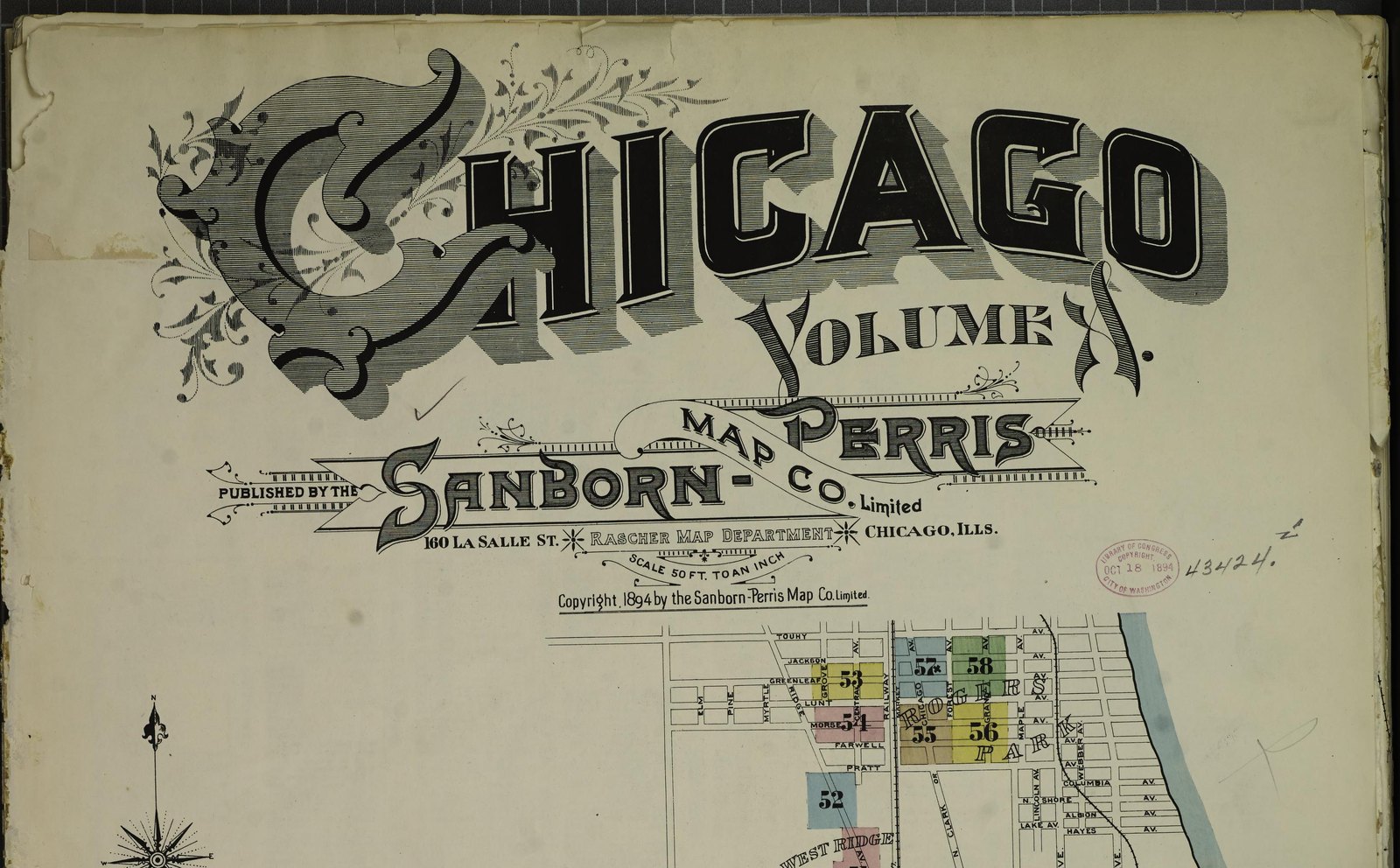
The lab is still here. Underwriters Laboratories grew into three UL organizations, and its testing business, UL Solutions, has traded on the New York Stock Exchange since April 2024. The federal Occupational Safety and Health Administration lists UL among its Nationally Recognized Testing Laboratories, and local electrical inspectors rely on listings from labs like it.7
The incentive for AI points the same way. The examiner’s questions go to the insurer, and the insurer stays responsible for a model it may not have built. A carrier in that position wants an independent answer it can hand to the examiner. That is the market for AI assurance.
For a government affairs shop, the lesson is where the questions get written. State regulators are drafting the exam questions now, in working groups with public calls and comment periods. Whoever shows up in those comment periods helps decide what an independent answer has to show, and that work happens long before any company sits for an exam.
My adjuster cannot check every contractor’s estimate by himself. An insurer cannot check every model by itself either. In 1894, the answer was an independent lab. It may be again.
Notes
- Late Nighter, “Bad Bunny Kicks Off Saturday Night Live’s 51st Season,” October 2025, https://latenighter.com/features/bad-bunny-kicks-off-saturday-night-lives-51st-season/; TV Insider, “’SNL UK’ Cold Open Mocks Ed Sheeran Refusing to ‘Take Sides’ in AI Princess Diana Takeover,” September 20, 2026, https://www.tvinsider.com/1292108/snl-uk-cold-open-mocks-ed-sheeran-refusing-take-sides-ai-princess-diana-takeover/.↩
- National Association of Insurance Commissioners, Big Data and Artificial Intelligence (H) Working Group, agenda, 2026 Fall National Meeting, Dallas, November 16, 2026, 12:00 p.m. to 1:00 p.m., item 4 (draft November 4, 2026), https://content.naic.org/sites/default/files/national_meeting/2026-fnm-agenda-bdaiwg20261116.pdf; Lexology, “NAIC Releases Version 7.0 of Its AI Risk Evaluation Supplement Ahead of Fall National Meeting,” November 13, 2026, https://www.lexology.com/library/detail.aspx?g=2c500c55-e04a-435b-a0e5-e203d2576b88.↩
- NAIC, “Market Conduct Regulation,” Center for Insurance Policy and Research, last updated May 15, 2025, https://content.naic.org/insurance-topics/market-conduct-regulation; NAIC, “AI Systems Evaluation Tool Pilot: Pilot Project Background,” https://content.naic.org/sites/default/files/inline-files/Pilot%20Project%20Summary_1.pdf; Lumenova AI, “Preparing for the NAIC AI Systems Evaluation Tool: An Insurer’s Readiness Guide,” November 10, 2026, https://www.lumenova.ai/blog/naic-ai-systems-evaluation-tool/; NAIC, “Artificial Intelligence,” Center for Insurance Policy and Research, https://content.naic.org/insurance-topics/artificial-intelligence.↩
- NAIC, “Artificial Intelligence,” https://content.naic.org/insurance-topics/artificial-intelligence (survey reports issued December 2022, August 2023, and December 2023); Verisk, “Roof Condition: Transforming Property Risk Management with Data-Driven Insights,” https://www.verisk.com/blog/roof-condition-transforming-property-risk-management-with-data-driven-insights/; Alston & Bird, “NAIC Summer Meeting Sharpens Focus on AI, Data, and Technology Governance,” September 21, 2026, https://www.alston.com/en/insights/publications/2026/09/naic-focus-ai-data-technology-governance.↩
- NAIC, “Model Bulletin: Use of Artificial Intelligence Systems by Insurers,” adopted December 4, 2023, https://content.naic.org/sites/default/files/inline-files/2023-12-4%20Model%20Bulletin_Adopted_0.pdf; Mayer Brown, “US NAIC Spring 2026 National Meeting Highlights,” April 2026, https://www.mayerbrown.com/de/insights/publications/2026/04/us-naic-spring-2026-national-meeting-highlights-innovation-cybersecurity-and-technology-h-committee-update.↩
- PBS, American Experience, “Tesla: The Columbian Exposition,” https://www.pbs.org/wgbh/americanexperience/features/tesla-columbian-exposition; UL Solutions, “UL Solutions at a Glance,” September 2023, https://www.ul.com/sites/default/files/2023-09/UL%20Solutions%20At%20a%20Glance.pdf; UL Research Institutes, “Our History,” https://ul.org/about/our-history/; “Underwriters Laboratories, Inc.,” International Directory of Company Histories, via Encyclopedia.com, https://encyclopedia.com/books/politics-and-business-magazines/underwriters-laboratories-inc.↩
- UL Research Institutes, “Our History,” https://ul.org/about/our-history/; Latham & Watkins, “Latham & Watkins Represents UL Solutions Inc. in Upsized US$1.08 Billion IPO,” April 17, 2024, https://www.lw.com/en/news/2024/04/latham-watkins-represents-ul-solutions-inc-in-upsized-us1-08-billion-ipo; Occupational Safety and Health Administration, “UL LLC,” Nationally Recognized Testing Laboratory Program, https://www.osha.gov/nationally-recognized-testing-laboratory-program/ul; IAEI Magazine, “Testing Agencies & the Electrical Inspector,” November 2017, https://iaeimagazine.org/2017/november2017/testing-agencies-the-electrical-inspector/.↩
Is this issue on your desk?
Start a conversation