
Today would have been James A. Garfield’s 195th birthday. Happy birthday, Mr. President!
In the summer of 1881, President Garfield lay wounded in the White House after an assassin shot him. William H. Crook, who had once been Abraham Lincoln’s bodyguard and now kept the White House accounts,1 got an unusual order. The consulting surgeons, Crook was told, hoped squirrel soup would build up the president’s strength; Garfield was “very fond” of it. Crook was to be ready to hunt the moment the doctors sent word. General Samuel D. Sturgis, commandant of the Soldiers’ Home,2 sent him a permit at once to hunt on the Home’s grounds, on a hill about three miles from the White House where Presidents Lincoln and Hayes had spent their summers.3 Crook believed it was the only time anyone had been allowed to go gunning there. “But I never used the permit,” he wrote, “for the doctors never sent me word to go out after the squirrels.”4
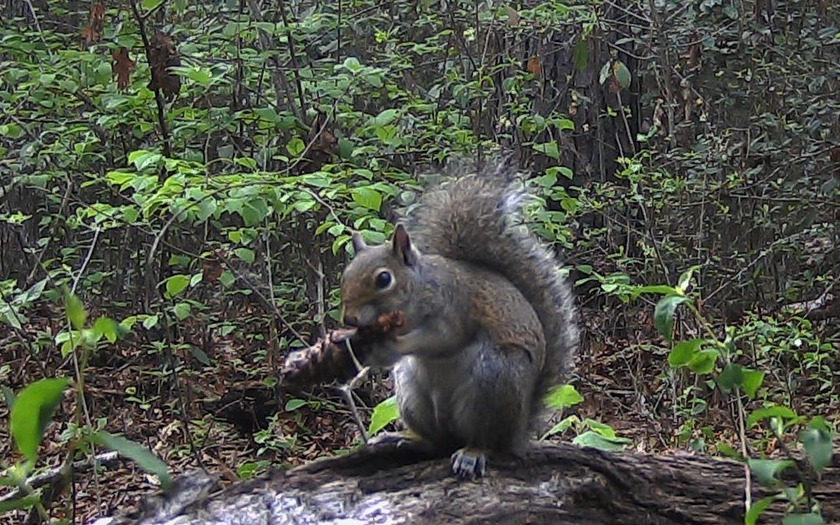
As evidenced by the taste for squirrel, Garfield was a country boy. He was born in Cuyahoga County, Ohio, on November 19, 1831, and raised on a frontier farm. At 16 he ran off to work the canal boats between Cleveland and Pittsburgh and fell overboard 14 times in six weeks. Like a lot of us who wandered a bit before settling on a career, he came home vowing to make his way “using brains rather than brawn.”5
He went to school, working his way through the Eclectic Institute in Hiram, Ohio, as its janitor. He graduated from Williams College in 1856 and came back to run the institute. He served in the Ohio legislature, rose to major general in the Civil War, and in December 1863 resigned to take a House seat he had won without campaigning.5 He represented northeast Ohio for 17 years and chaired the Appropriations Committee from 1871 to 1875.6 In 1880, he became the first president elected straight from the House, and he is still the only one.7
Garfield’s presidency lasted only two hundred days.7 Charles Guiteau, a lawyer turned drifter,7 who believed Garfield’s victory had earned him a consulship in Paris,8 shot the president on July 2, 1881, at the Baltimore and Potomac railway station in Washington. The station was torn down in 1908, and the site now holds the National Gallery of Art.9 Searching for the bullet, the doctors probed the wound with unwashed fingers.7 That was the summer Crook waited for word to go after the squirrels. The word never came. After lingering 80 days,8 Garfield died on September 19, two months shy of his 50th birthday.6
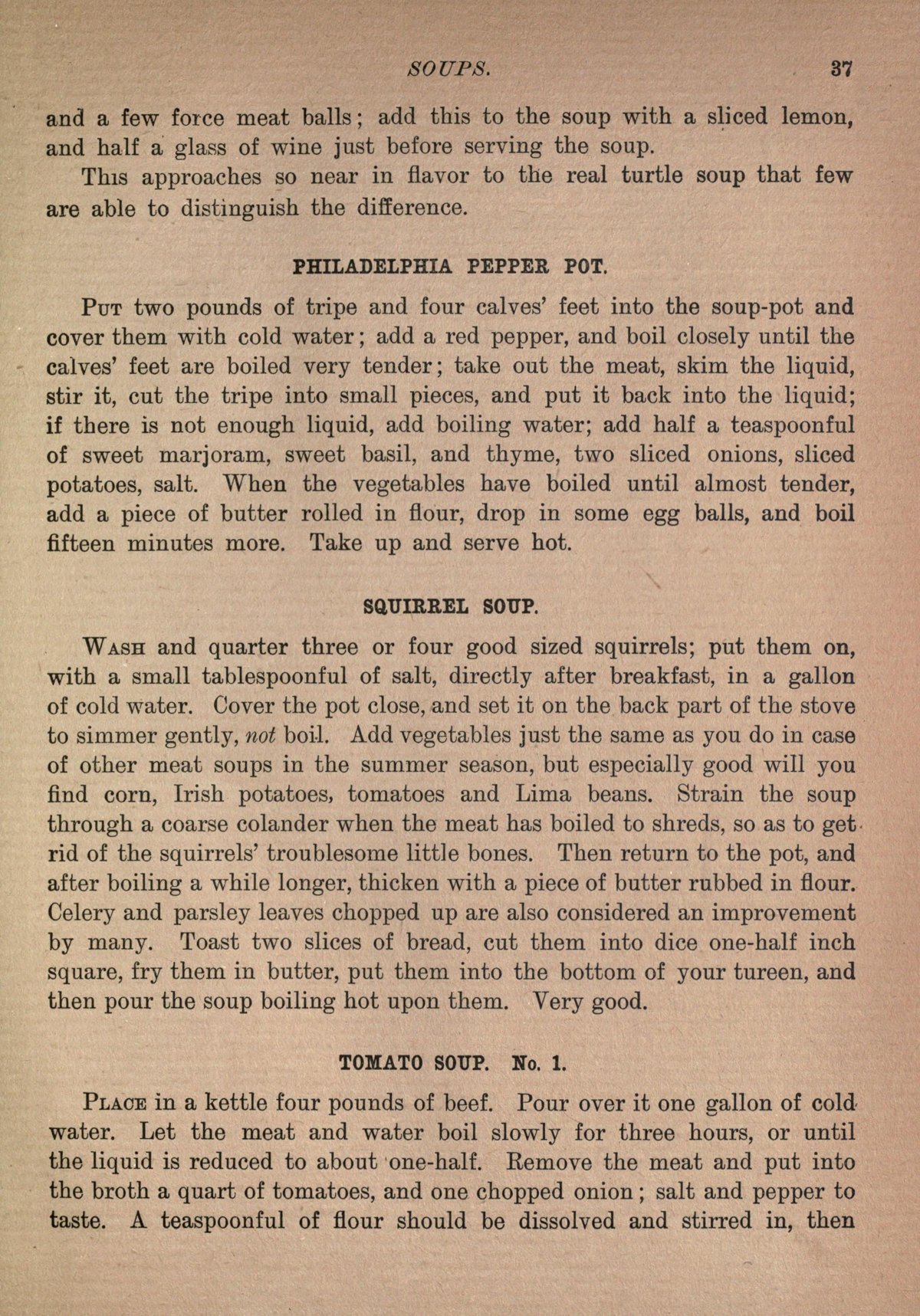
The squirrel soup he never got is preserved in the White House Cook Book of 1887, written by F. L. Gillette with Hugo Ziemann, steward of the White House.10 The recipe asks for patience more than skill:
Wash and quarter three or four good sized squirrels; put them on, with a small tablespoonful of salt, directly after breakfast, in a gallon of cold water. Cover the pot close, and set it on the back part of the stove to simmer gently, not boil. . . . [E]specially good will you find corn, Irish potatoes, tomatoes and Lima beans. Strain the soup . . . when the meat has boiled to shreds, so as to get rid of the squirrels’ troublesome little bones. Then return to the pot, and . . . thicken with a piece of butter rubbed in flour. . . . Toast two slices of bread, cut them into dice one-half inch square, fry them in butter, put them into the bottom of your tureen, and then pour the soup boiling hot upon them. Very good.10
The same book prints menus for every day of the week, month by month. Its dinner planned for Thursdays in November opens with squirrel soup and follows it with roast loin of mutton, boiled potatoes, mashed squash, fried cabbage, and olives, then apple puff pudding with grandmother’s sauce, nuts, raisins, fruit, and coffee. The book also plans birthday dinners for George Washington and Ulysses S. Grant. Sadly, Garfield doesn’t get a birthday menu.10 Since his birthday falls on a Thursday this year, cook the book’s November Thursday dinner to celebrate.
In case you’re short on squirrel, use bone-in chicken thighs, which give the long simmer something to work with. Put two pounds of thighs, three quarts of water, and a tablespoon of salt in a covered pot on the lowest heat for about an hour and a half. Pull the meat off the bones with two forks instead of straining the soup, return it to the pot with corn, diced potatoes, some fresh tomatoes (or a can if you need to), and lima beans, and simmer until the potatoes are tender. Two tablespoons of butter worked into two tablespoons of flour thicken it. Parsley and a little celery go in at the end, and the buttered croutons go in the bowl first, the way the book says. I love to cook with lamb, and a lamb shoulder, roasted slowly, is what I would put on this table instead of the mutton. Homemade bread and some good butter will do.
Years ago a colleague from Ohio offered to take me rafting and squirrel hunting, with squirrel soup at the end of the day. I never went, and I still regret it. Whether you make squirrel or chicken soup, don’t be like Garfield’s doctors: wash your hands before you start. Before digging in, raise a glass to the only man to go directly from the House to the White House. Drink what you like, but beer is thematically appropriate: Garfield “liked beer and drank but little else.”11 Happy birthday, Mr. President.
Notes
- W. H. Crook, Memories of the White House: The Home Life of Our Presidents from Lincoln to Roosevelt, comp. and ed. Henry Rood (Boston: Little, Brown, 1911), title page (“some time bodyguard to Lincoln, since then disbursing officer of the Executives”) and 154, https://hdl.handle.net/2027/uc2.ark:/13960/fk8v98082j.↩
- “Samuel Davis Sturgis,” Find a Grave, memorial 6522, accessed November 15, 2026, https://www.findagrave.com/memorial/6522; Crook, Memories of the White House, 156.↩
- President Lincoln’s Cottage, “Other Presidential Residents,” accessed November 18, 2026, https://www.lincolncottage.org/other-presidential-residents/; Johnny Di Lascio, “A Tour of President Lincoln’s Cottage that Almost Didn’t Happen,” President Lincoln’s Cottage, January 8, 2020, https://www.lincolncottage.org/a-tour-of-president-lincolns-cottage-that-almost-didnt-happen/.↩
- Crook, Memories of the White House, 155–56.↩
- Miller Center, “James A. Garfield: Life Before the Presidency,” University of Virginia, accessed November 14, 2026, https://millercenter.org/president/garfield/life-before-the-presidency.↩
- National Park Service, “James A. Garfield,” accessed November 14, 2026, https://home.nps.gov/articles/000/james-a-garfield.htm.↩
- National Park Service, “James Garfield: The Great ‘What If’ President,” accessed November 15, 2026, https://www.nps.gov/articles/james-garfield-the-great-what-if-president.htm.↩
- National Park Service, “The Federal Civil Service and the Death of President James A. Garfield,” accessed November 15, 2026, https://www.nps.gov/articles/000/the-federal-civil-service-and-the-death-of-president-james-a-garfield.htm.↩
- Richard Brownell, “The Short-Lived Baltimore & Potomac Railroad Station on the National Mall,” Boundary Stones, WETA, June 29, 2016, https://boundarystones.weta.org/2016/06/29/short-lived-baltimore-potomac-railroad-station-national-mall; National Park Service, “James Garfield’s Legacy,” National Mall marker, transcribed at the Historical Marker Database, https://www.hmdb.org/m.asp?m=127347.↩
- F. L. Gillette and Hugo Ziemann, The White House Cook Book (1887), “Squirrel Soup,” “Menus: November,” “Washington’s Birthday,” and “General Grant’s Birthday Dinner,” Project Gutenberg, https://www.gutenberg.org/ebooks/13923; page images from the 1901 printing (New York: Saalfield), University of California Libraries, Internet Archive, https://archive.org/details/whitehousecookbo00ziemrich.↩
- Thomas Donaldson, “The Memoirs of Thomas Donaldson, 1881–1893,” Rutherford B. Hayes Presidential Library and Museums, accessed November 18, 2026, https://www.rbhayes.org/research/the-memoirs-of-thomas-donaldson-1881-1893/.↩
Is this issue on your desk?
Start a conversation