
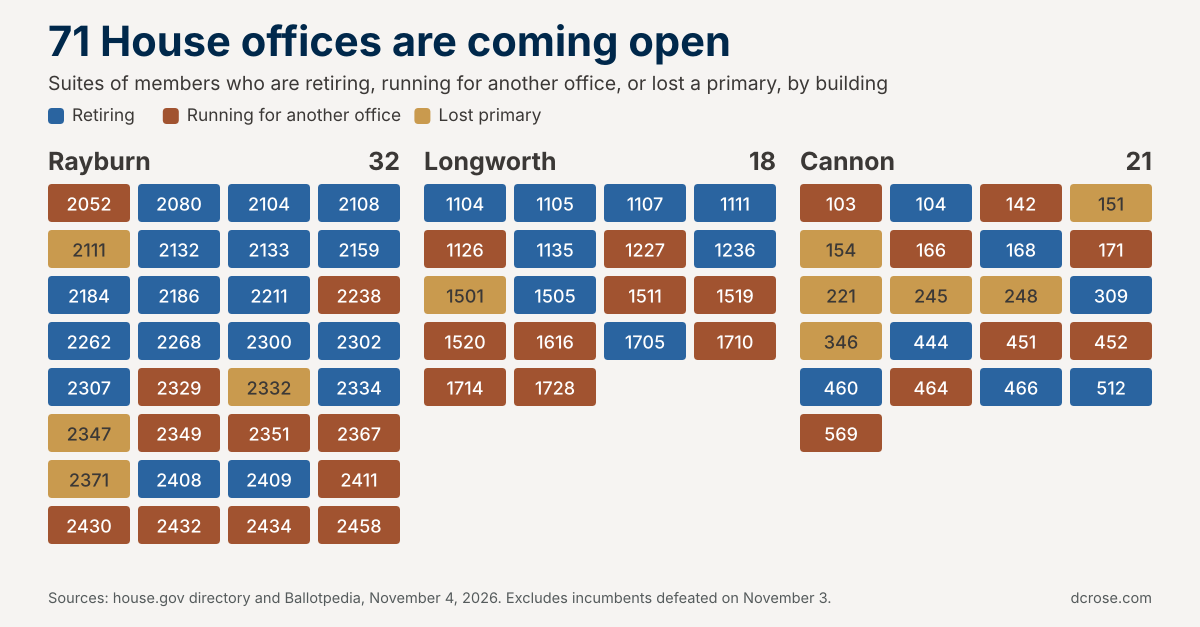
On Sunday, November 8, the newest members of the House start arriving in Washington for orientation, which runs through November 18.1 Before they leave, they will learn how to cast a vote, draw numbers in the office lottery, and begin building a staff from nothing.
Some of the House’s most senior members are leaving, among them Steny Hoyer, the longest-serving Democrat in the House, now in his 23rd term; Jerrold Nadler, in his 18th; and Sam Graves, the Missouri Republican who chairs the Transportation and Infrastructure Committee, in his 13th.2 Their suites, including 1705 Longworth and 2132 Rayburn, are unlikely to reach the freshmen.3 Returning members choose first, by seniority, and the freshmen then draw lottery numbers for what is left.4
The lottery gets the photographs. The hiring gets less attention and matters more. I would argue that the decision that matters most in a new member’s office is made in November, when the staff is hired and before you know whom to call. The February meeting comes after those choices are set.
The staff is the part that lasts for the whole term. Each House member may employ up to 18 permanent employees and 4 more in categories such as interns and part-time staff. A member-elect starts with none of them, and most of those jobs will be filled before the new terms begin on January 3.5 There is no committee seat yet, either. Each party’s steering committee recommends committee assignments, usually between December and late January, and the full party caucus approves them.6
The House’s own numbers show how early those choices stick. After the 2020 election, the Chief Administrative Officer offered each member-elect a paid transition aide to help set up the Washington and district offices. Of the 61 members-elect, 50 took one. Of those 50 aides, 47 were then hired into the member’s permanent office.7 The person who helps build the office usually stays in it.
In my experience, the chief of staff hired this month sets the office’s habits for the whole term: who gets a meeting, which issues get a staffer, and how the member learns a subject the campaign never touched. Those first hires tend to come from people the member already trusts, such as campaign aides, state legislative staff, and alumni of the state’s congressional delegation. The pool is small, and it fills fast.
Last month, I wrote that the staff who know your issue may not be back. This is the other half of the same calendar. Retiring members have already picked their move-out dates, most of them this month.1 Some of those offices did not plan to move. At least 11 House incumbents lost on Election Day, and others lost their primaries.8 Their staffs are looking for work, too. The departing offices are packing up while the arriving ones are assembled from scratch.
What to do before January 3:
- Learn who is being hired, and for which seat, before you ask for a meeting. The chief of staff, district director, and legislative director come first, and each one shapes whom the office hears from.
- Start in the district. In my experience, members-elect spend most of the weeks after orientation at home. A site visit there means more than a hallway meeting in Washington.
- Work the delegation. Senior staff in the same state’s delegation know the candidates and often know your issue. They are the fastest route to an office that does not exist yet.
- Bring a briefing, not an ask. A member-elect has no committee, no bill, and no staff to hand a request to. A two-page explanation of how your issue touches the district will still be on the desk in January.
The new terms start on January 3. The new offices start this month.
Notes
- Maeve Sheehey, “Incoming House Members Will Descend on Washington Next Week,” Bloomberg Government, November 2, 2026, https://news.bgov.com/bloomberg-government-news/incoming-house-members-will-descend-on-washington-next-week.↩
- Office of the Clerk, U.S. House of Representatives, “Terms of Service for Members of the House of Representatives in the 119th Congress,” November 2, 2026, https://clerk.house.gov/member_info/Terms_of_Service.pdf; Associated Press, “Rep. Steny Hoyer, the Longest-Serving House Democrat, to Retire at the End of Term,” NPR, January 8, 2026, via High Plains Public Radio, https://www.hppr.org/npr-news/2026-01-08/rep-steny-hoyer-the-longest-serving-house-democrat-to-retire-at-the-end-of-term; “Another Senior House Republican Will Retire as Midterm Exodus Grows,” New York Times, March 27, 2026, via GV Wire, https://gvwire.com/2026/03/27/another-senior-house-republican-will-retire-as-midterm-exodus-grows/; Andrew Solender, “Longtime Rep. Jerry Nadler to Retire in 2026, Bowing to Democratic Age Revolt,” Axios, September 2, 2025, https://www.axios.com/2025/09/02/nadler-retire-2026-democrats-ny.↩
- U.S. House of Representatives, “Representatives,” accessed November 4, 2026, https://www.house.gov/representatives.↩
- Architect of the Capitol, “House Office Moves: Suite Stakes,” https://www.aoc.gov/what-we-do/projects/congressional-office-moves/house.↩
- 2 U.S.C. § 5321(a), https://uscode.house.gov/us/usc/119-118/t2/s5321/; U.S. Const. amend. XX, §§ 1–2, https://constitution.congress.gov/constitution/amendment-20/.↩
- Judy Schneider, House Committees: Assignment Process, CRS Report 98-367 (Congressional Research Service, updated December 1, 2004), https://www.everycrsreport.com/files/20041201_98-367_bbb326d0627035fe73fcb1d420e4ef1b619b00c0.html; “House GOP Freshmen Nab Coveted Committee Spots,” Axios, December 13, 2024, https://www.axios.com/2024/12/13/house-republican-freshman-committees; Office of the Democratic Leader, “Leader Jeffries Announces Appointments to Committees for the 118th Congress,” press release, January 26, 2023, https://democraticleader.house.gov/media/press-releases/leader-jeffries-announces-appointments-committees-118th-congress-0.↩
- Catherine L. Szpindor, Chief Administrative Officer, U.S. House of Representatives, statement before the Select Committee on the Modernization of Congress, January 20, 2022, https://docs.house.gov/meetings/MH/MH00/20220120/114329/HHRG-117-MH00-Wstate-SzpindorC-20220120.pdf.↩
- Ballotpedia, “United States House of Representatives Elections, 2026,” accessed November 4, 2026, https://ballotpedia.org/United_States_House_of_Representatives_elections,_2026.↩
Is this issue on your desk?
Start a conversation